
How to Pronounce the English th (and Why You Keep Saying t, d, or s)
English has two th sounds Spanish lacks, so your tongue swaps them for t, d, or s. The exact tongue mechanics to fix it for good.
- pronunciation
- phonetics
- common mistakes

You say I tink dis instead of I think this, and you catch it a second after it leaves your mouth. Or you order three coffees and the barista hears tree. This isn't carelessness or a gap in your level. English has two sounds, the voiceless th in think and the voiced th in this, that Spanish doesn't carry in its inventory, so your tongue grabs the closest letter it owns and swaps in a t, a d, or an s.
The good news: the th isn't fixed with effort, it's fixed with position. It's a continuous sound, not a tap. The tip of your tongue makes the lightest contact with the edge of your upper teeth, and air flows out through the gap without stopping. Put the tongue where it belongs and let the air run, and the sound shows up on its own.
It's not you: the th is rare worldwide
These sounds are genuinely rare. Dental fricatives like the th show up in only 43 of 566 languages, 7.6% of the WALS sample. As phonetician Ian Maddieson puts it: "Dental or alveolar non-sibilant fricatives are just as rare as labial-velar plosives, occurring in just 43 (or 7.6%) of the languages surveyed." Spanish is one of the many languages that lack them, so your ear never built a template for them. You're not starting at a disadvantage, you're starting from zero.
Peninsular Spanish with distinción has half the work done already. If you tell casa apart from caza, you already produce a /θ/ every time you say caza or cielo, the exact same sound as in think. The rest of the Spanish-speaking world (seseo) merged that sound into an s, which is why think ends up coming out as sink.
The exact mechanics: where the tongue goes
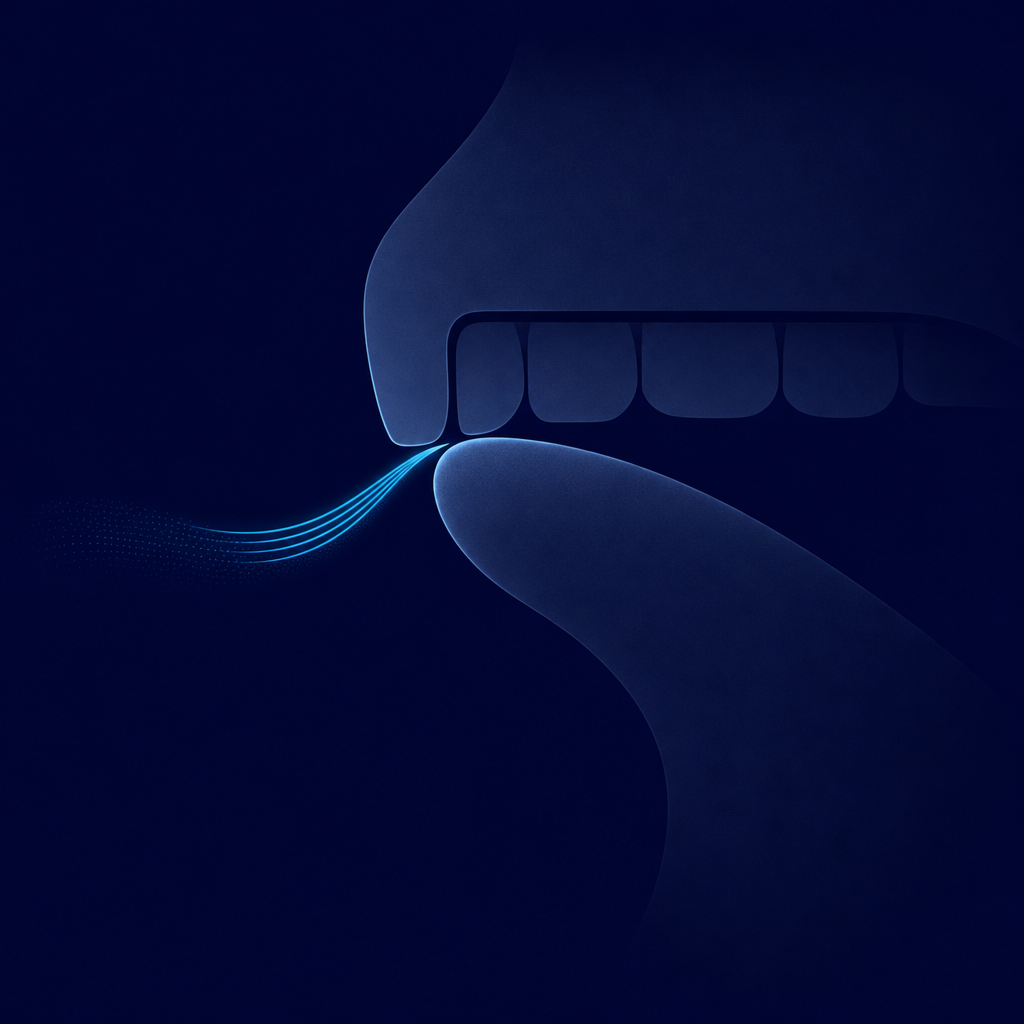
The position is precise and small. The textbook An Introduction to American English Phonetics, by Ton Broeders and Carlos Gussenhoven, describes it: "The tip of the tongue forms a light contact with the inner edge of the upper front teeth while resting on the cutting edge of the lower front teeth." A light contact, not pressure. Press the tongue against the teeth and you cut off the air, and the sound turns into a t or a d.
You don't have to stick your tongue out like in the cartoons. The dental version, with the tip behind your upper teeth, sounds just as good. The British Council boils it down to two steps: tongue between the teeth without protruding much, and push air through the gap.
Think or this: the only thing that changes is voice
Both th sounds share the same tongue position; the only difference is voicing. The one in think, three, or math is voiceless: just air. The one in this, the, or mother is voiced: you add vocal-cord vibration on top of the same posture. Put your hand on your throat. If it buzzes, it's the th in this; if it doesn't, it's the one in think. A shortcut that rarely fails: the grammar words (the, this, that, they, them, there) all take the voiced th.
Your mistakes already have names (and fixes)

Every substitution is predictable and carries a technical label: swapping th for t or d is called th-stopping; for f or v it's th-fronting, and for s or z it's th-alveolarization. Teacher Ana Paula Biazon Rocha describes it this way: "The verb 'think' /θɪŋk/ might be pronounced as 'sink', 'zink', 'fink', or even 'tink'." The problem survives even at high levels: Spain scores 540 on the EF English Proficiency Index, a "High" band, and the th still gives the accent away. In one study with Spanish speakers, the voiced th in this was produced correctly only 43.4% of the time.
Knowing where the tongue goes and doing it at conversation speed are two different things. Could you say I think that's three out loud right now without a t slipping in? That automation, saying the phrase in real time instead of just understanding it, is exactly what Tabla makes you repeat out loud and scores with speech recognition.
:::self-check A waiter asks "anything else?" and you want to answer "I think that's all". What do you physically do with your tongue so it doesn't come out "I tink dat's all"?
Rest the tip of your tongue lightly against the edge of your upper teeth and let the air flow without cutting it off; press, and you get t or d. In think the air runs voiceless, and in that's you add the buzz in your throat (voiced). Same tongue, the only thing you change is voice. :::
Next time a word starts with th, slow down for half a second, rest your tongue on your teeth, and let the air run instead of tapping a t. Repeat it out loud until it stops feeling deliberate.
Try this today: record yourself saying "three free trees" and "this, these, those" three times, put your hand on your throat, and check that three doesn't buzz and this does.