
Thirteen or Thirty: Why English Numbers Slip Past Your Ear
You hear the price and cannot tell 13 from 30. It is not vocabulary: English hides the difference in stress and in a vowel that Spanish never empties out.
- numbers
- pronunciation
- common mistakes

The cashier says the total, you hear something between thirteen and thirty, and you hand over a big bill so you don't have to ask. This isn't a vocabulary problem. You've counted to a hundred since middle school. English buries the difference in two places Spanish leaves alone: where the beat lands, and what happens to the syllable that doesn't carry it. A second obstacle sits on top of that one, and it's cognitive. Your brain still retrieves exact figures in Spanish, so every spoken number costs an extra translation step at the moment you have three seconds to answer. The fix is mechanical and fits in one afternoon. Learn where the stress goes, empty out the second syllable, and spell the digits when the number matters.
The beat lands in a different place
The difference between thirteen and thirty lives in the stress, not at the end of the word. In thir-TEEN the beat falls on the second syllable and the vowel comes out long and clear. In THIR-ty it lands on the first, and the second collapses into a short, neutral sound. University pronunciation programs teach it as a one-line rule: Tools for Clear Speech at Baruch College (CUNY) instructs learners to "stress the second syllable of 'teen' numbers" and the first syllable of "ten" numbers.
Spanish never hollows out that second syllable, and that's why your thirty comes out sounding like thirteen. Spanish gives every vowel a full body, stressed or not. Emily Byers and Mehmet Yavaş measured the habit in 60 speakers and found that late Spanish-English bilinguals stretch the final unstressed vowel to 0.117 seconds against 0.073 in monolinguals. That's about 60% more vowel than English expects to hear there.
Wrong: thir-TEE, second syllable full and round, as if it were Spanish. Right: THIR-dy, beat at the front, ending almost swallowed. In American English that t also softens into a d. The scene: a mechanic in Tampa quotes you thirty for the service, you hear thirteen, and the argument starts once the car is already in pieces.

Misplaced stress is not a cosmetic detail. Manisha Ghosh and John M. Levis tested it with 69 listeners and concluded that "English word stress errors affect intelligibility most when they introduce concomitant vowel errors": a wrong beat does the most damage when it drags a vowel change along with it, which is precisely this pair. The native listener doesn't even wait for the end of the word to decide. Alexandra Jesse and her colleagues confirmed it with eye-tracking: "Before critical word pairs became segmentally distinguishable in their 3rd syllables, participants fixated target words more than their stress competitors". They resolved the number from the rhythm while you were still waiting on a final n that fast speech never delivers.
The ear retrains fast. Maria Kondaurova and Alexander Francis trained 29 Spanish speakers over a handful of sessions and the learning carried over to words they had never practiced.
Your brain still does the math in Spanish
Exact numbers stay stored in the language you learned them in. Stanislas Dehaene and his team established the principle in Science: "Exact arithmetic is acquired in a language-specific format, transfers poorly to a different language or to novel facts". The times tables you memorized at eight live in Spanish, and they don't move to English just because you did. Elizabeth Spelke and Sanna Tsivkin confirmed it by training bilinguals in one language only: exact figures came back far better in the language of training, while approximate quantities traveled between the two for free.
That penalty survives years of practice, and it gets worse when the number arrives through your ears. Amandine Van Rinsveld studied 193 bilinguals and sums up the mechanism this way: "Solving arithmetic problems is a cognitive task that heavily relies on language processing". In her experiment, the error rate on spoken addition problems hit 34% in the second language against 22% in the first. Hearing a price and working out the change is that task exactly, with a cashier watching you.
Knowing the rule isn't enough. It has to arrive before your brain routes through Spanish. Spoken English prices come in two blocks with no dollars in the middle: $4.95 is "four ninety-five" and $13.30 is "thirteen thirty", carrying the same stress pair you just saw. Could you say those out loud right now without translating first? That kind of automation under time pressure is what the Drum Challenge in Tabla drills, the thirty-second round that opens every practice session.
Why the phone number falls apart halfway through
Your immediate memory for digits shrinks the moment you switch languages. Sven Mattys, Alan Baddeley and Danijela Trenkic measured the drop across 72 people: participants held 8.84 digits in their native language and only 5.77 when the same numbers came in English. Three digits fewer. That's the exact gap between holding a phone number and losing it midway.

Don't try to hold the whole string. Break the number into blocks of three or four and repeat each block out loud as you hear it, instead of waiting for the end. Saying it out loud moves the digits off fragile memory and back into your ear.
Wrong: listening to all ten digits in silence and trusting they'll stick. Right: "five-five-five... okay... two-oh-nine...", repeating block by block while the other person keeps talking. The scene: a clinic receptionist in Chicago reads out your insurance number at native speed, and by the middle you've already lost the beginning.
When the number matters, spell it out
Commercial aviation stopped trusting spoken English numbers decades ago. EUROCONTROL requires that "all numbers should be transmitted by pronouncing each digit separately" precisely because two and three, or five and nine, get confused systematically even among professionals who do this every day. English level has nothing to do with it. The channel does.
The industry numbers back it up. An analysis of 191 NASA reports found that the ten thousand / eleven thousand pair showed up in 38% of altitude deviations, and in an IATA survey of 2,070 pilots, numeric homophones ranked as the second most cited communication problem. If pilots need a protocol, you can use one without feeling clumsy.
Steal the habit for your own life. When you confirm an account number, a flight time or a dosage, say it digit by digit and ask them to confirm it back. "Let me read that back to you: one, four, zero, three." Nobody will look at you strangely. That's what a professional sounds like.
You're on the phone with a store in Miami and they tell you the order arrives "on the thirteenth." How do you confirm the date without walking away unsure?
Repeat the number pulled out of the sentence: "The thirteenth? One-three?" If they answer "yes, one-three," it's settled. The trick is to lift the figure out of the sentence and spell it, because inside the sentence the stress on thirteenth shifts and stops being a reliable cue. Confirming digit by digit doesn't sound rude in English. It sounds like someone who doesn't want mistakes.
"03/04/2026" means nothing on its own
A date written in digits is ambiguous by design once it crosses the Atlantic. In the United States, 03/04/2026 is March 4th. In Spain and across most of Latin America, it's April 3rd. The ISO created standard 8601 specifically "to remove the confusion caused by the many different date and time formats used worldwide, which can lead to misinterpretation and costly errors", fixing the order as year-month-day so nothing is left to guess.
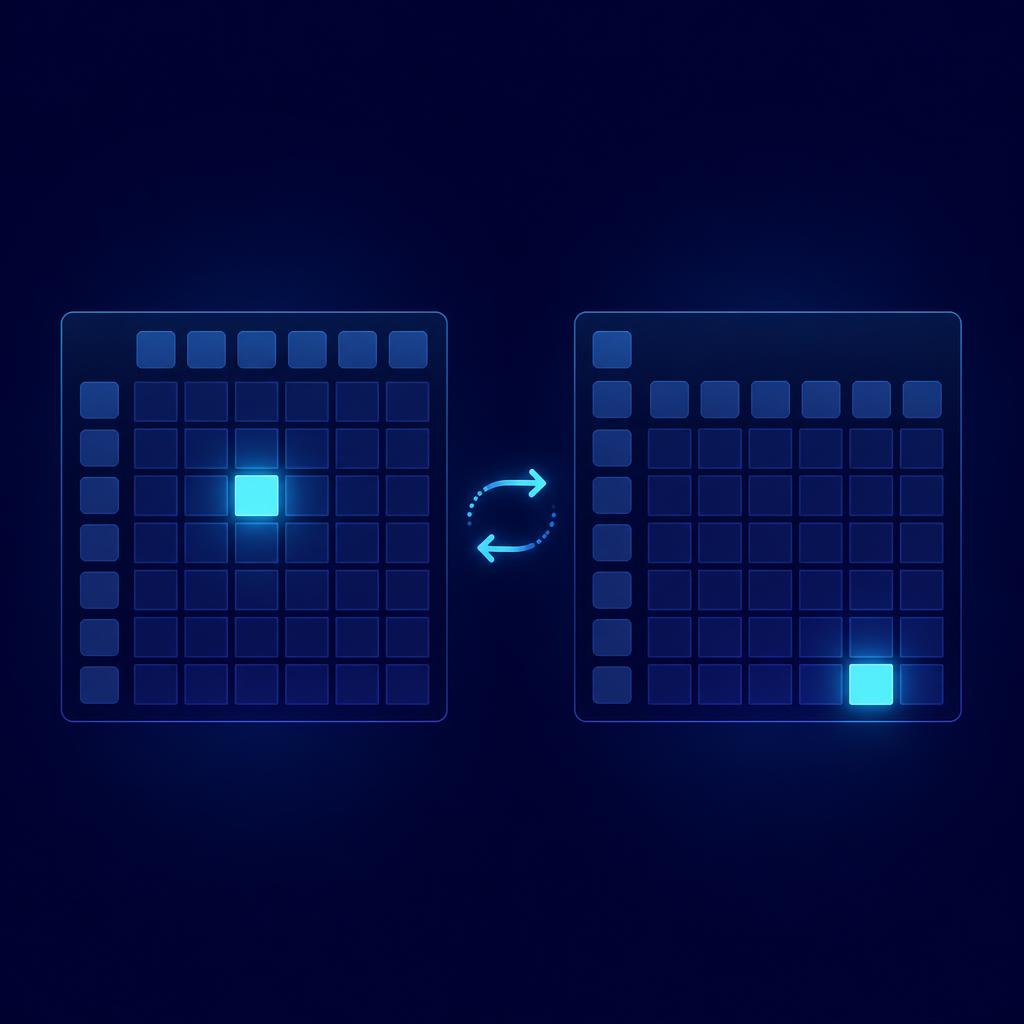
In practice, solve it by speaking instead of writing. Say the month by name and the ambiguity vanishes.
Wrong: writing "see you on 03/04" in an email to a client in New York. Right: "see you on March 4th," or in a formal document, 2026-03-04. The scene: a designer in Bogotá delivers on April 3rd a project her New York client expected on March 4th, and neither of them wrote the date incorrectly.
Numbers are the one piece of vocabulary you already know completely and still can't catch by ear. Start with the pair that costs you the most money. Next time you hear a price, hold on to where the beat landed, not to how the word ended.
Try this today: record yourself saying "thirteen, thirty, fourteen, forty, fifteen, fifty" three times, play it back, and check that in the -ty words your second syllable is shorter than your first.