
Talking to Yourself in English: The Habit That Builds Fluency Fastest
Talking to yourself in English feels ridiculous, but saying phrases out loud—with no audience—trains your fluency faster than any hour of silent study.
- speaking practice
- habits
- fluency

Talking to yourself out loud sounds eccentric, but it's one of the fastest ways to get English out of your head and into your mouth. Saying phrases aloud, even with nobody listening, forces you to produce the language, and production is the one thing silent study never demands. You can follow every word of a podcast and still freeze when it's your turn, because comprehension and production are separate skills that train separately. A few minutes a day narrating your life in English builds automaticity faster than an hour spent reading grammar rules. Memory science and second-language research both point the same way, and you can start today, for free, in your kitchen.
Understanding a language and producing it are two different muscles
Comprehension alone won't teach you to speak. Merrill Swain found this while studying French-immersion students who, after years of rich input, still stumbled the moment they had to produce. Her output hypothesis came out of that gap: speaking forces you to process language in a way listening never triggers. In producing the target language, she wrote, "learners may notice a gap between what they want to say and what they can say", and closing that gap is what drives learning. Talk to yourself and you generate that production pressure with nobody in front of you.
Saying a word out loud burns it into memory better than reading it

Voicing what you study measurably improves recall. Cognitive psychology calls it the "production effect." Colin MacLeod and his team showed in 2010 that "producing a word aloud during study, relative to simply reading a word silently, improves explicit memory". Talking to yourself stacks retrieval practice on top: pulling a phrase out of your head and saying it is a mini-test. Karpicke and Roediger measured that effect with foreign vocabulary and found that learners who tested themselves recalled "about 80% a week later, versus just 36% for those who kept rereading". Read a phrase silently and you get the illusion of knowing it. Say it out loud and you fix it.
Talking to yourself isn't weird: it's a stage of learning
Researchers have documented talking to yourself for decades as a normal part of learning. Sociocultural theory calls it "private speech": language aimed at yourself to organize thought. María de Guerrero, the leading specialist, notes that "roughly 30 years ago researchers started to take a focused interest in the study of inner speech and private speech processes in second language learning". Amy Ohta, after a year recording classrooms, described that self-talk as "a creative locus of linguistic manipulation and hypothesis testing". The mutter you make while rehearsing what you're about to say isn't a flaw. It's the scaffold your brain uses to turn conscious rules into automatic speech.
Repeating out loud makes you faster, and there are numbers
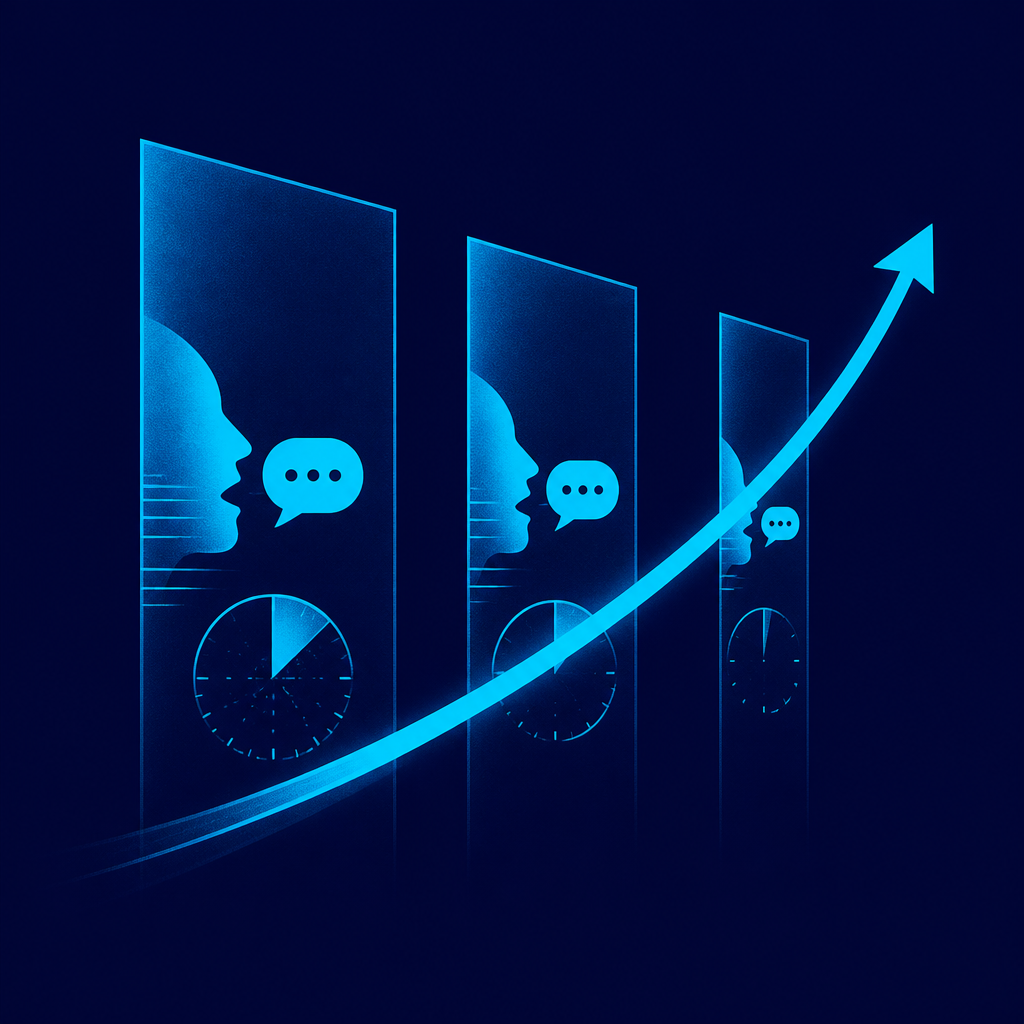
Repeating out loud speeds up your speech in measurable ways. Paul Nation tested the 4/3/2 technique, telling the same story three times, first in four minutes, then three, then two: one speaker went from 86 to 127 words per minute between her first and third delivery, a 48% increase. In a later study with twenty learners, Arevart and Nation recorded an average 21.5% jump in speaking rate and a drop in hesitations of up to 76% from the first delivery to the third. They didn't change their vocabulary or study more. They just repeated out loud.
How to talk to yourself without wasting your time
Talking to yourself works when you do it with intention, not as background noise. Narrate what you're doing while you cook ("I'm chopping an onion, now I'll heat the pan"), rehearse tomorrow's conversation aloud, or read a paragraph out loud every day; the British Council flatly recommends practicing speaking out loud when you have no one to talk to. The one weakness is that nobody corrects you: you can repeat a mistake a hundred times without noticing. Could you say that phrase right now and know whether your pronunciation is right? Tabla is built on exactly that: you speak aloud against a recognizer that scores each attempt and plays back the correct pronunciation, then turns what you practiced into a personalized podcast to hear again. It's talking to yourself, but with something that actually listens.
You don't need an app, a teacher, or a partner to start. You need to open your mouth. Next time you're alone at home, pick a phrase you usually avoid and say it out loud until it comes without effort.
Try this today: pick a task you'll do anyway (washing the dishes, walking to work) and narrate the whole thing in English out loud for three minutes, without stopping to hunt for the perfect word.