
The Myth of Learning English Through Games: When Duolingo Helps and When It Stalls You
Streak-and-points apps build a daily habit and recognition, but leave you speechless. Here is the research on why, and what to do to actually speak.
- methods
- habits
- gamification

You're 200 days into a streak on your English app. You recognize hundreds of words, you nail almost every exercise, and then a tourist asks you for directions and you freeze. This isn't a discipline problem. It's the method. Gamified apps (streaks, points, multiple choice) build two real things: a daily habit and passive recognition of vocabulary and grammar. What they barely build is the ability to speak. The reason is mechanical. Points reward tapping the right answer, not producing it out loud, and producing is exactly what trains speech.
What the apps genuinely do well
The daily habit is these apps' biggest win, and it's no small thing. The famous headline that "34 hours of Duolingo equal one college semester" comes from a 2012 study that measured reading, vocabulary, and grammar on a placement test. It never tested speaking. Duolingo's own efficacy study, published in 2020, found that learners reached an intermediate level in reading but stayed at a novice level in listening. The gains are real, but they're receptive: understanding, not producing.
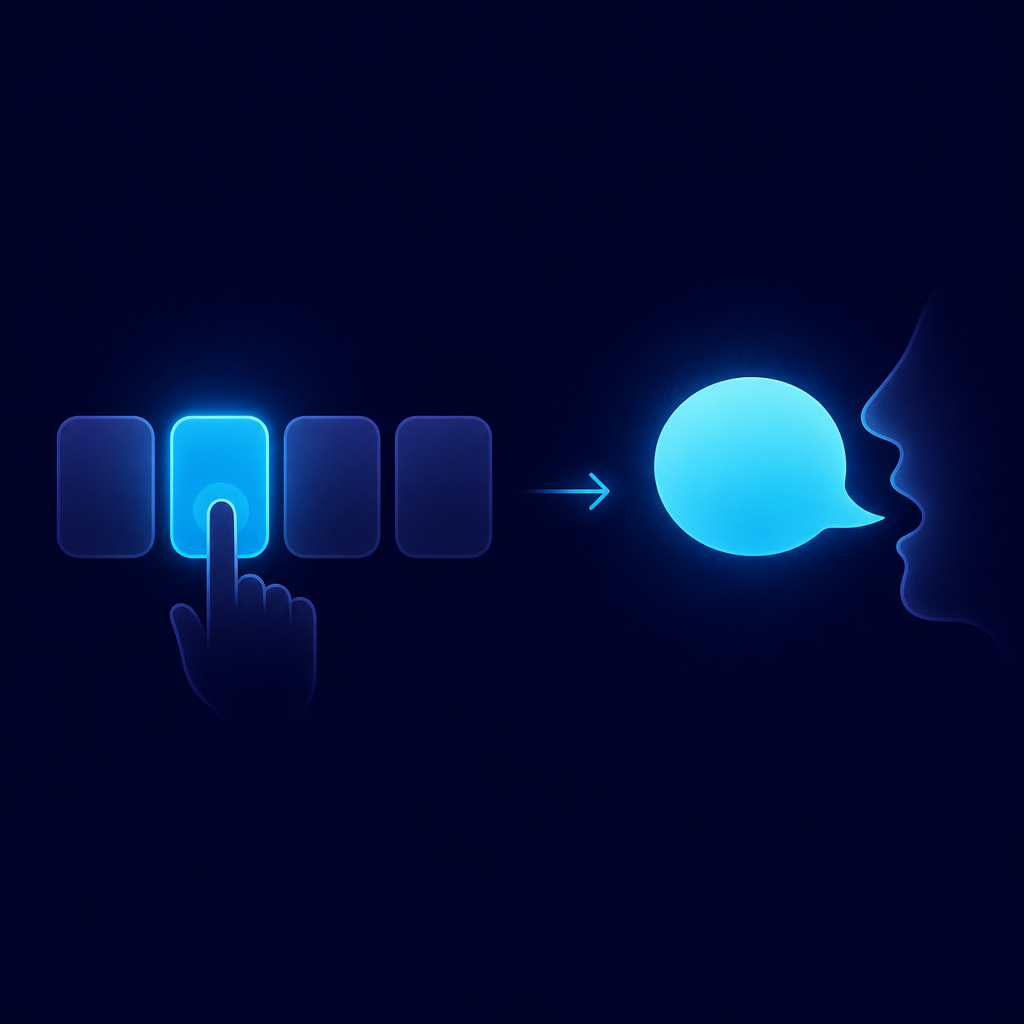
Recognizing is not the same as producing
Picking the right multiple-choice answer overstates what you actually know. Cognitive science calls it the illusion of competence. Recognizing the correct answer feels like learning, but Roediger and Karpicke's 2006 experiments showed that retrieving information from scratch, with no cues, produces far stronger retention, even though it feels harder and less rewarding. Tapping the right word among four options is recognition. Saying it out loud with nobody showing it to you is production. Only the second trains what you use in a conversation.
Why speaking changes what you learn
Producing the language forces you to process it more deeply than merely understanding it. Since Merrill Swain's 1985 output hypothesis, second-language acquisition research establishes that speaking forces you to notice the gaps in your knowledge and to resolve syntax in real time, something comprehension skips over. Swain put it this way about learners who only receive input: "there is no push to be more comprehensible than they already are." Without the pressure to produce, you never move past half-understanding. An app that only asks you to recognize never triggers that push.
Streaks and points: the motivation that burns out
Points and streaks light up motivation at first, then they snuff out the long-term kind. A 2020 meta-analysis on gamification found small effects: g=0.49 on cognitive outcomes, 0.36 on motivation, and only 0.25 on behavior, and the motivational effects were the least stable. Deci, Koestner, and Ryan's 128-study meta-analysis further showed that external, controlling rewards, the psychological cousins of points and streaks, reduce the intrinsic motivation to do something for its own worth. The streak isn't bad in itself. The trouble starts when keeping the streak becomes the goal, and speaking English stops being one.

What to do to actually start speaking
The fix isn't to quit the apps. It's to swap half your practice for production. Instead of tapping answers, say the sentences out loud until they come without thinking. Tabla is built around exactly this: every exercise asks you to pronounce the phrase out loud and a speech recognizer scores it, so you practice by producing, not by recognizing. Could you say out loud, right now and without translating, the last sentence you "learned" by tapping a screen? That gap between recognizing it and saying it is what leaves you speechless in front of the tourist. And it isn't just you: in the 2024 EF index, Latin America's English level has been stuck for years, precisely on productive use. Back in 2014, Stephen Krashen warned that "there is no clear evidence that Duolingo is effective in teaching foreign languages." A decade later, the evidence that exists still measures mostly receptive skills.
Tomorrow, before you open the app, say three sentences you already "know" out loud. If you struggle, it's not that you don't know them. It's that you never produced them.
Try this today: pick the five words you recognize best in your app and record yourself using each one in a full sentence out loud. On playback, the ones you hesitated on are the ones you only recognized.